PixGamma has its own models, trained on the Mac with traiNNer-redux on the GPU (MPS) and converted to Core ML. A model only ships when it beats the current one on both benchmarks: the scored photo set and a full-pipeline run on real photos.
Choosing a base model
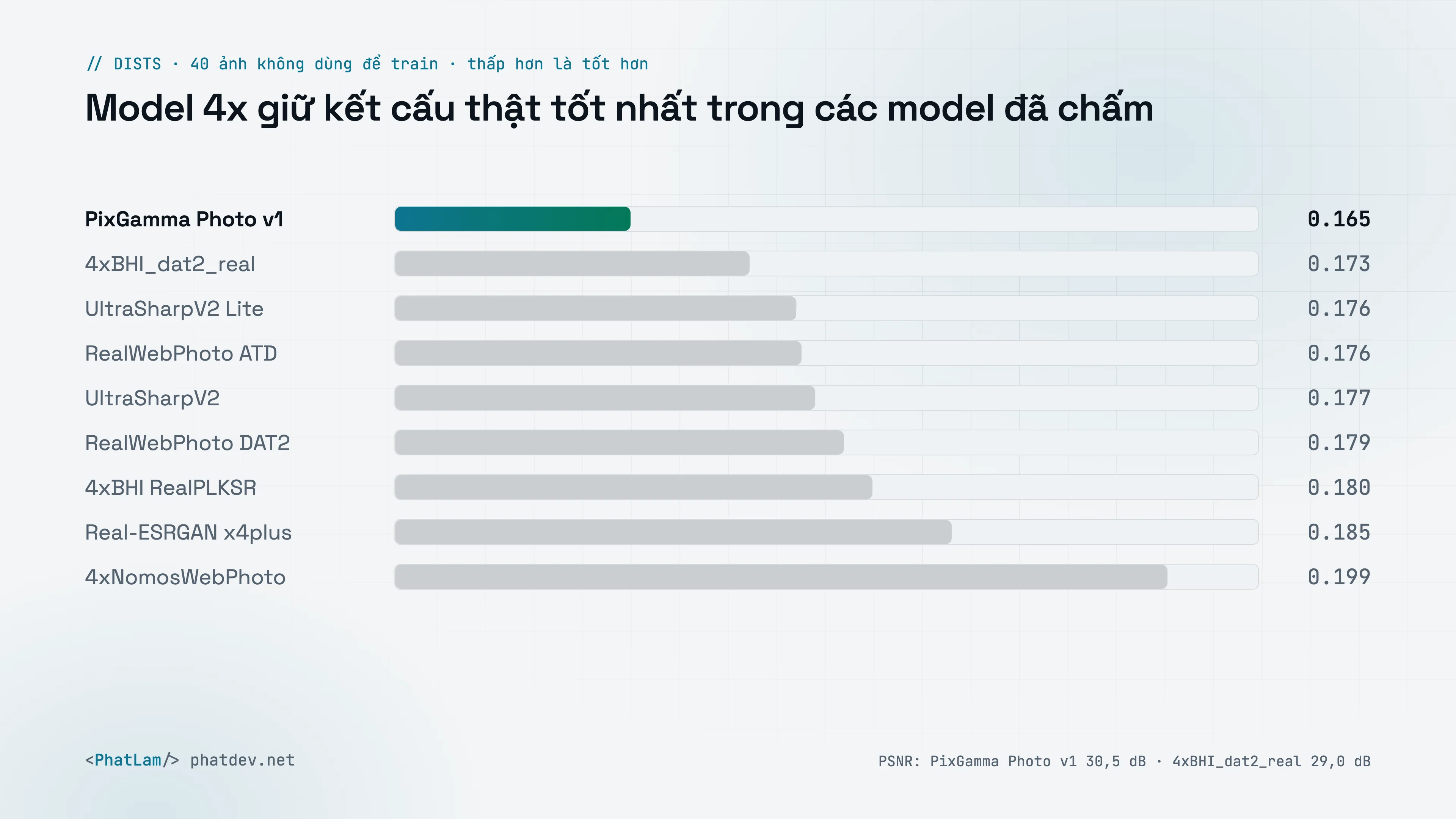
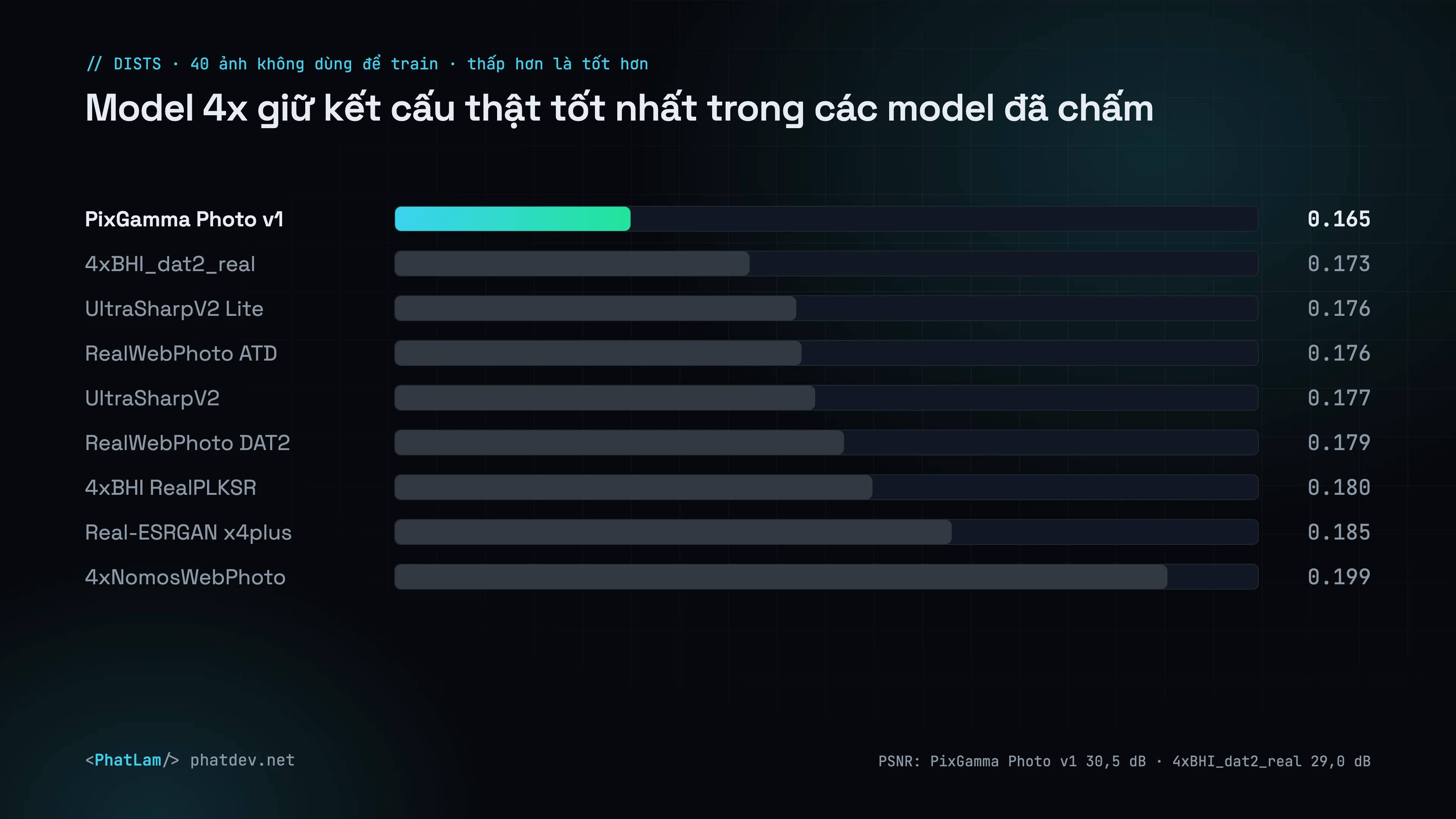
PixGamma scored highly rated public 4x models (Hugging Face, OpenModelDB, GitHub) on 40 photos never used for training: 22 laptop shots plus portraits, animals, fabric and leather. The main metric is DISTS (texture similarity, lower is better), alongside PSNR.
| 4x model | DISTS |
|---|---|
| PixGamma Photo v2 | 0.164 |
| PixGamma Photo v1 | 0.165 |
| 4xBHI_dat2_real (base of Photo v1) | 0.173 |
| UltraSharpV2 Lite | 0.176 |
| RealWebPhoto ATD | 0.176 |
| UltraSharpV2 | 0.177 |
| RealWebPhoto DAT2 | 0.179 |
| 4xBHI RealPLKSR | 0.180 |
| Real-ESRGAN x4plus | 0.186 |
| 4xNomosWebPhoto (Photo model in 0.1) | 0.199 |
PSNR on the same set: PixGamma Photo v1 30.5 dB, 4xBHI_dat2_real 29.0 dB, 4xNomosWebPhoto 26.9 dB.
PixGamma Photo v2 (default photo model)
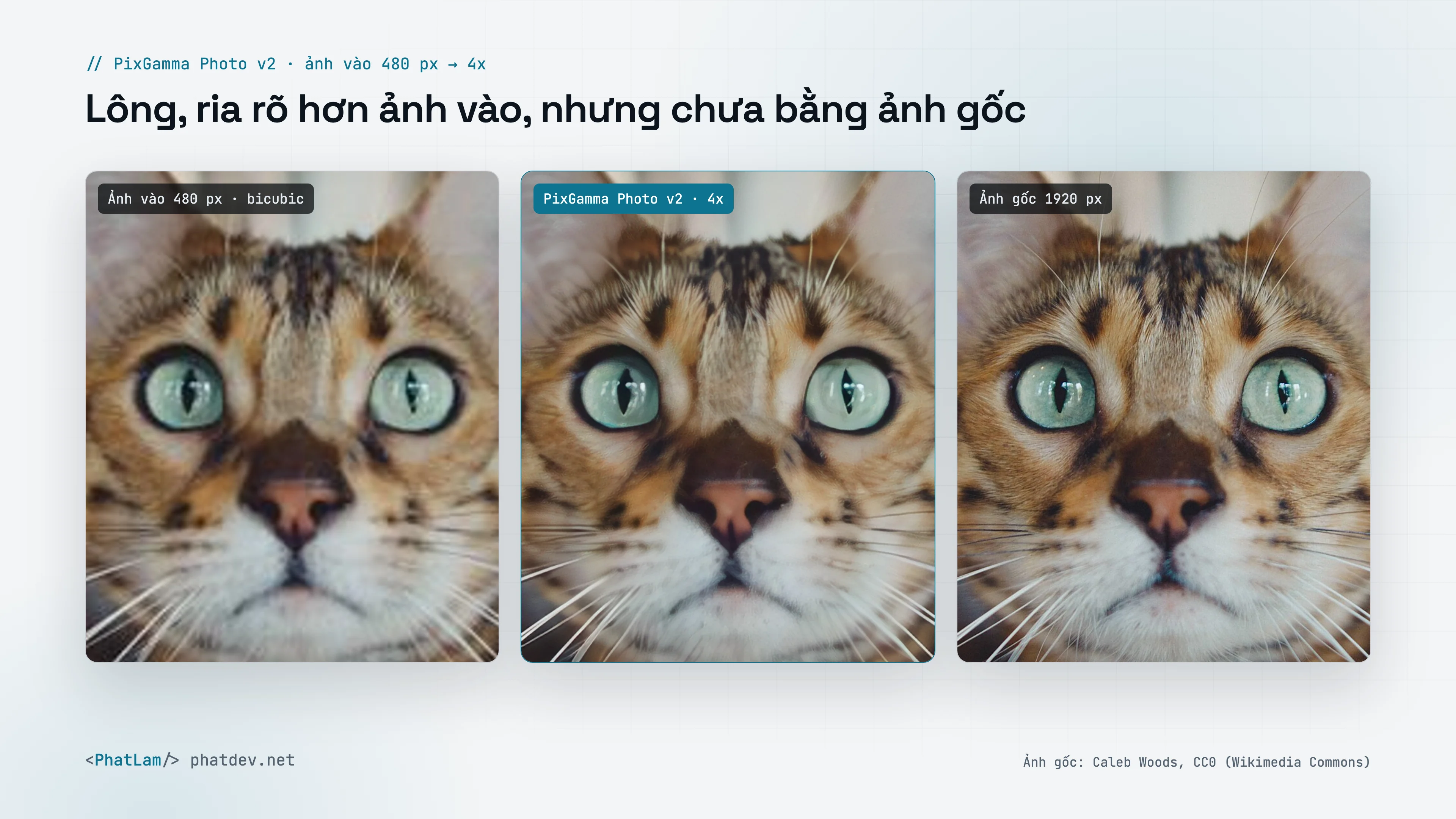

- Photo v1 trained further with a light GAN for crisper fur, hair and fabric grain.
- DISTS on the 40-photo set: 0.164 (v1: 0.165); on sharp photos: 0.170 (v1: 0.183).
- Text regions keep Photo v1 (no GAN), so the GAN never draws letter strokes.
- A second round with a stronger GAN scored worse and is not shipped.
- Photo v2 is a 4x model; 2x upscales still use SPAN.
PixGamma Photo v1
- DAT2 architecture, fine-tuned for 15,000 iterations from 4xBHI_dat2_real (Philip Hofmann, CC-BY-4.0).
- Data: CC0 and public-domain photos from Wikimedia Commons, with artwork and sensitive images filtered out and the benchmark photos excluded. Half of the low-resolution inputs go through a downscale + double JPEG chain like web images; 2,500 synthetic text tiles keep strokes intact.
- Losses: Charbonnier and MS-SSIM (pixel accuracy), LDL (artifact suppression), focal frequency (high frequencies), DISTS (real texture). No GAN, so the model does not invent texture.
- Result: the base DAT2 brightens images by about one gray level and shifts dark areas; v1 shows almost no color drift.
Tried and not shipped
| Version | Tried | Why not |
|---|---|---|
| First Photo v2 (0.2.1) | v1 plus a light GAN, used on text too | Broken small text, jagged key edges; the current build keeps text regions on Photo v1 |
| Photo v2 round 2 | A stronger GAN | Scored worse than the shipped v2 |
| Text v4 | Text model with thin white strokes | Sharper but read 4.3 px capitals worse |
| Photo v1 for 2x | 4x then shrink to 2x | Lost to SPAN 2x on 5 of 6 photos in the full pipeline |
Text model
0.2.0 used a dedicated text model (RealPLKSR fine-tuned from 4xNomosWebPhoto in three rounds on synthetic Vietnamese and English text: 114 fonts with Vietnamese, random syllables covering every diacritic combination, banners, labels, keyboards). Since 0.2.1 text regions use Photo v1, which reads better; the text model stays in the app as a fallback.
Tooling
| Script | Does |
|---|---|
training/fetch_commons.py |
Downloads CC0 and public-domain photos from Wikimedia Commons with credits |
training/prepare_dataset.py |
Cuts tiles and builds low-resolution inputs with a web-like degradation chain |
training/make_text_dataset.py |
Generates Vietnamese and English text tiles |
training/evaluate.py |
Scores PSNR, DISTS and color drift |
training/eval_text.py, eval_text_pipeline.py |
Score text with per-line, per-size OCR |
tools/convert_extra.py |
Converts checkpoints to Core ML and checks the difference against PyTorch |
Every base model has an open license (CC-BY-4.0, BSD-3-Clause, Apache-2.0, MIT, OpenRAIL-M); CodeFormer is non-commercial only.